The art world is complex, capricious and often difficult to navigate. It can, therefore, be particularly daunting when inheriting an artwork or an entire collection without proper knowledge of the myriad divesting…
Continue reading

The art world is complex, capricious and often difficult to navigate. It can, therefore, be particularly daunting when inheriting an artwork or an entire collection without proper knowledge of the myriad divesting…
Continue reading

David Hilliard, He Said, She Said, 2005, three-panel archival pigment print, 24 x 60 or 40 x 90 inches.
Before the inevitable change of seasons, Robin Rosenberg Fine Art would like to celebrate the last few weeks of summer by sharing some works by artists who are making a splash. Whenever you’re ready to dive into art collecting, please be sure to contact us here.
Related Posts
Art in Full Bloom
Spring Cleaning: Art Edition
Celebrating Black Artists
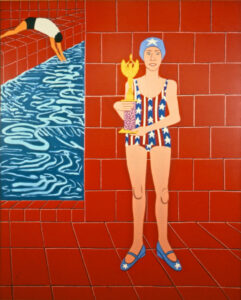
Joan Brown, The Bicentennial Champion, 1976, enamel on canvas, 96 x 78 inches.

Massimo Vitali, #2303 Coney Es, 2006, lightjet print from negative scan on photographic paper on diasec with wooden frame, 35 2/5 x 43 3/10 inches, Edition 35 of 35 + 4AP.

Carole A. Feuerman, Miniature Brooke with Beach Ball, 2018, mixed media with resin, Edition 14/38, 12 x 16 x 12 inches.
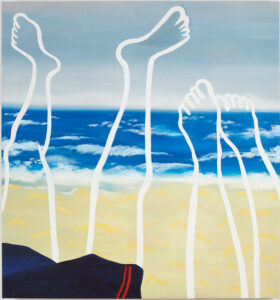
Hiejin Yoo, Doing Our Favorites, 2018, flashe and oil on canvas, 30 x 28 inches.
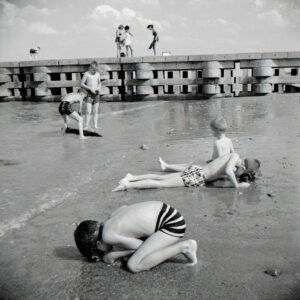
Vivian Maier, 0119304 1963 Kids Digging For Clams, 2017,modern gelatin silver print, 12 x 12 inches.

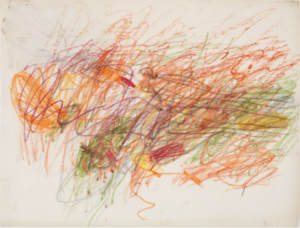
Cy Tombly, Untitled, 1954, mixed media on paper, 19 x 25 inches. Museum of Modern Art, New York.
Most art enthusiasts have been confronted, at one time or another, with a friend or family member’s derisive reaction to a piece of Modern or Contemporary art; “I could do that” or, “my kid could do that”. Disregarding the fact that even minimalist artwork takes more time, effort and technical prowess than most take into consideration, even if you or your child sincerely could produce an artwork in question, this reaction still proves to be a rather unhelpful response to art.
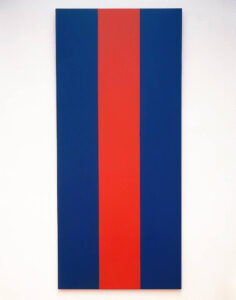
Barnett Newman, Voice of Fire, 1967, 213 x 94 inches, National Gallery of Canada, Ottawa.
People tend to overlook the fact that an artwork’s significance is not exclusively limited to its visual properties. Any Art History 101 class will repeatedly emphasize the importance of art’s contextual aspects. Artists are influenced by their socio-political and personal realities and, therefore, their artwork is inextricably linked to various situational circumstances. As an onlooker, you, nor your offspring, share the personal motivations or particular social realities that the artist experienced and, therefore, could not have been a position to produce the same artwork they did.
Related Posts
Conceptual Art: What is it?
Thinking Outside the Box
The Rise of Graffiti and Street ArtThe Rise of Graffiti and Street Art
It is also important to consider conceptual art which, as its name aptly implies, involves an artwork being used as a vehicle through which a concept or idea is manifested. An artist’s goal is not always to impress viewers with their incredible craftsmanship, but can be to convey a message or elicit a response.
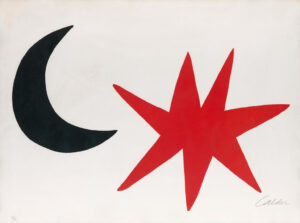
Alexander Calder, Mond und Stern, 1965, Lithograph, 30 x 22 inches. Edition of 100.
So, the next time you find yourself in the presence of an artwork that does not impress you aesthetically, fight the urge to shrug it off. Investigate further, read a gallery wall label or do a quick google search so you can learn about the artist’s background and get a better sense of the ‘why’ as opposed to solely the ‘what’ in terms of the art they produce.



Hank Willis Thomas, Raise Up, 2014, bronze, 112 1/5 × 9 4/5 × 3 9/10 inches, edition of 5.
All over the world, people are protesting the ongoing oppression and brutality Black people experience. Our current global situation is encouraging all demographics to re-examine their actions, words and privileges in order to better support Black voices and communities in hopes of overcoming racial injustice.
The art world is certainly not exempt from this fight. The canon of Art History overwhelmingly favours white male artists. As an art firm, we feel it is our responsibility to contribute to changing this damaging narrative by using our platform to both acknowledge the exclusionary nature of our industry and help overcome it by continuously touting our support for and recognition of talented Black artists.
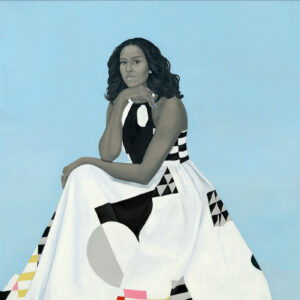
Amy Sherald, First Lady Michelle Obama, 2018, oil paint on linen, 72 x 61 inches, National Portrait Gallery.
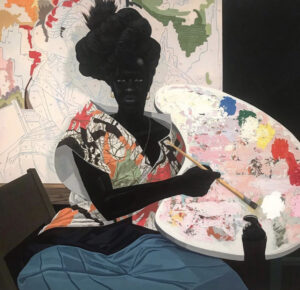
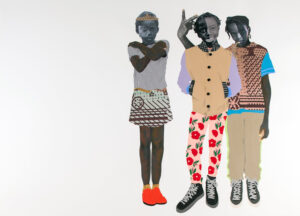
We would like to shine a spotlight on several contemporary Black artists whose respective artistic practices engage with and challenge ideas concerning racial stereotypes and forms of representation as well as systemic oppression.
Amy Sherald made waves in recent years as the artist behind First Lady Michelle Obama’s revered official portrait. Her work primarily focuses on realism and portraiture, depicting Black subjects. She engages with African American storytelling and raises questions concerning skin colour, exhibited through her poignant choice to use grey shades for skin in her portraits.
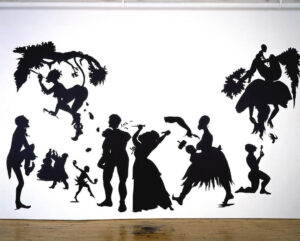
Installation photo from Kara Walker’s Narratives of a Negress at the Tang Teaching Museum, 2003.
Kara Walker is a multidisciplinary artist based in the United States. She is most well-known for her work using large scale black cut paper silhouettes as well as her sculptures made from the unique material, sugar. Walker’s oeuvre engages with the history of slavery along with race, gender, violence, identity and the Black experience of both the past and present.
Related Posts
What’s Love Got to Do With It?
Kehinde Wiley: Maker of Modern Royalty
ARTspiration: Appropriation in Art
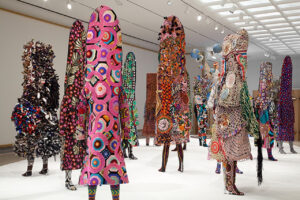
Installation photo from Nick Cave’s Here Hear exhibition at the Cranbrook Art Museum, 2015.
Nick Cave is a sculptor, dancer and performance artist, internationally celebrated for his Soundsuits. These sculptures are wearable, surreal works that are inspired by the history of racial violence in the United States. They are vehicles of empowerment as their outward representations obscure visible markers of race, gender and class.
We welcome you to continue to engage with the work of Black artists by clicking on the images featured throughout this blog post.
Selected work by artists included are available through Robin Rosenberg Fine Art. For details, please contact us here.



Frank Gehry’s Guggenheim Museum Bilbao, Bilbao, Spain.
When visiting an art museum, we expect to encounter art within its walls. Focusing our attention solely on a museum’s collection, however, one fails to acknowledge the fact that museum edifices themselves are often artistic masterpieces in their own right. Museums are dynamic structures that are built with innovative materials and boast striking designs and powerful shapes. To celebrate International Museum Day, we are highlighting only a handful of the many museums whose architectural components are as noteworthy as the artworks housed within.
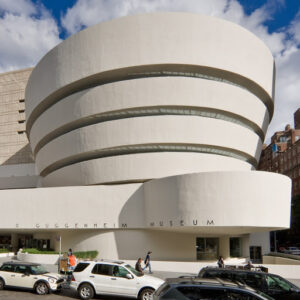
Frank Lloyd Wright’s Solomon R. Guggenheim Museum, New York City, United States of America.
New York City’s iconic Solomon R. Guggenheim Museum comes to mind when contemplating noteworthy museum architecture. Designed by Frank Lloyd Wright, the unique winding structure is nestled within its largely linear cityscape. It has clean, fluid lines, curving, spiraling walls, and a smooth exterior texture free of visible windows. In both its form and concept, the Guggenheim offers unique viewing experiences and its sculptural brilliance renders it a noteworthy art piece in and of itself.
The Guggenheim Museum Bilbao is one of the most admired buildings in contemporary architecture. Characterized by its structural ingenuity and appeal, the museum was designed by Canadian-American architect Frank Gehry. The museum is situated in Bilbao’s port area on the Nervion River. Gehry’s extensive use of titanium and glass and his use of dramatic and exaggerated curves and shapes offer a modern cutting-edge style that resembles a boat. The surface of the building mimics rippling water, as light catches and refracts along with the curved titanium. Gehry illustrates the creative potential of harmonizing both natural and industrial surroundings in order to create a structure that is both complex and dynamic.
Related Posts
Check-in and Check-out the Art!
Alexander Calder: Radical Inventor
Conceptual Art: What is it?
Zaha Hadid was a British-Iraqi architect who is internationally renowned for her boundary-pushing designs, particularly for museums and art galleries. Her futuristic aesthetic is evidenced by her predilection for glass and metallic materials as well as her bold and dynamic shapes. Her construction of the Heydar Aliyev Cultural Centre, in Baku, Azerbaijan is celebrated for its ground-breaking employment of sweeping fluid curves, and rounded lines built to reflect the building’s natural surroundings.

Zaha Hadid’s Heydar Alivey Cultural Center, Baku, Azerbaijan.
The next time you visit an art museum, be sure not only to admire the artwork inside but also the exterior and structural components of the building as well!
While we are currently unable to visit museums in person, many are offering virtual tours online. Please feel free to explore museum collections in the comfort of your own home with the provided links throughout the article.

Installation view of Hilma af Klint’s “The Ten Largest” Solomon R. Guggenheim Museum
The arrival of springtime ushers in warmer weather, promising a rebirth after the long winter months. Although this year looks a little different and we are forced to remain in hibernation mode, the birds will not cease to chirp nor the flowers to bloom. To celebrate this time of year, we highlight two prominent early 20th century female artists who embrace flowers as subjects in their work, Georgia O’Keefe and Hilma af Klint.
Both women were part of a radical subset of artists who rejected the formal teachings of painting and experimented with a new kind of abstraction by creating art that did not reflect subjects as they appeared in the real world.
Hilma af Klint’s botanicals are totally untethered to the physical world as they appear to spiritually dance and float across the picture plane, as opposed to traditional realistic renderings of florals typically portrayed in vases or in a garden setting. Af Klint’s flowers can be described as ethereal, futuristic and symbolic.
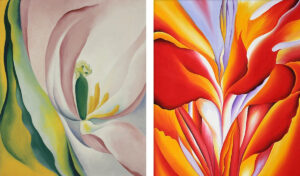
(Left) Georgia O’Keeffe, Pink Tulip, 1926 (Right) Georgia O’Keeffe, Red Canna, 1924, Georgia O’Keeffe Museum
Related Posts
Art Market Review: From Spring Auctions to Basel
Celebrating Two Iconic Female Artists: Cindy Sherman and Barbara Kruger
Spring Cleaning: Art Edition
O’Keeffe’s compositions also deviate from realism, as her overly magnified depictions of flowers render them virtually unrecognizable as such, or as any physical object for that matter. Ironically, her paintings are so detail-oriented that her illustrations served as resources to botanical scientists.
In their own unique styles, expressions, and interpretations of the same subject matter, both artists significantly contributed to a new era of abstraction that reframes and distorts the beauty of organic life.
While we patiently await springtime’s full bloom, we hope that you enjoy these floral oeuvres. The Robin Rosenberg Fine Art team hopes that you are healthy and that you take the time to celebrate spring!
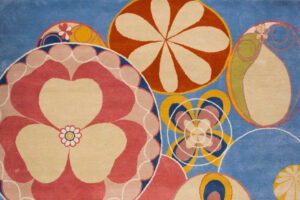
Hilma af Klint, detail of Group IV, no 2. The Ten Largest, Youth.

Felix Gonzalez-Torres, Untitled (Perfect Lovers), 1991, 14 x 28 x 2.75 inches, MoMA
Love is a universal theme that has been explored in art since antiquity. Contemporary artistic representations of love are not always easy to decipher so to celebrate Valentine’s Day this year, we are delving into several pieces that touch on this multifaceted emotion in unexpectedly poignant ways.
Felix Gonzales-Torres’ conceptual piece, Untitled (Perfect Lovers) explores the act of being in love as well as love’s imperfect nature. Two clocks placed side-by-side work in perfect synchronization and their continuous ticking represents a shared heartbeat. Slowly over time, they fall out of sync and, eventually, their batteries die before being re-set to begin the process once again. Torres’ work metaphorically represents his own personal relationship with his partner who tragically died of AIDS. The clocks speak to the harrowing feeling of running out of time. The gradual falling out of sequence, and ultimate malfunction evokes devastating loss.
Related Posts
Valentine’s Day: Artists in Love
Let There Be Light! James Turrell & Ellsworth Kelly
Conceptual Art: What is it?

John Baldessari, Valentine, 2015, 38 × 34 inches, edition of 50
In John Baldessari’s 2015 screenprint Valentine, the artist inscribes an arrow on a pre-existing fashion photograph of supermodel Kendall Jenner. The arrow represents Cupid’s signature accessory that the fictitious character uses to strike people and, in turn, makes them fall in love unexpectedly. Baldessari’s graffiti is at once playful and strategic, as the arrow strikes through Jenner’s bodice that is contoured by her garment’s neckline in a way that makes it resemble a heart shape.
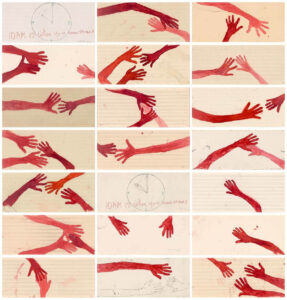
Louise Bourgeois, 10 am is When You Come to Me, 2008, 98 x 108 inches, Tate Museum
Louise Bourgeois’ piece, 10 AM is When You Come to Me, portrays a series of hands rendered in different tones of red that are continuously reaching towards each other in space. The hands belong to Bourgeois and her assistant Jerry Gorovoy, whom she trusted and loved deeply. The colour red evokes the warmth, passion and emotional intensity of their love. The piece’s title refers to the time of the morning when Gorovoy would arrive at the artist’s studio to commence their workday together.
Unlike artworks such as Auguste Rodin’s famous sculpture The Kiss, Robert Indiana’s widely recognized pop LOVE images or Jim Dine’s signature hearts, the pieces discussed evoke the theme of love in more conceptual and obscure ways that may take a bit more time and effort to fully comprehend.

Robert Indiana and Fernando Botero sculptures at LHotel, Old Montreal
Travellers looking to immerse themselves in culture and the arts instinctually flock to museums. The increasing trend of hotels doubling as public gallery spaces, however, allows visitors to view high-quality art by simply booking a stay. Instead of purchasing decorative art en masse from manufacturing companies, establishments are adopting a more discerning eye in terms of what graces their walls and lobbies.
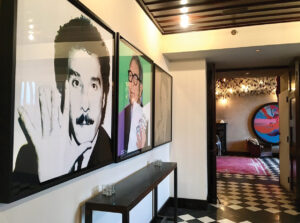
Andy Warhol and Damien Hirst at the Gramercy Park Hotel, NYC
The Gramercy Park Hotel in NYC is a great example, as it boasts a fabulous collection replete with artwork by the likes of Andy Warhol, Damien Hirst, George Condo, Julian Schnabel, among others. Miami is another city with an array of hotels featuring stunning collections, notably the Sagamore Hotel in South Beach known for its rotating exhibitions of museum quality art year-round. To our fellow Montrealers, if you are looking to stay local, check out LHotel in Old Montreal, a boutique hotel filled with 20th-century art where passersby are greeted with impressive large-scale Robert Indiana and Fernando Botero sculptures.
Related Posts
Beyond the Border: Canadian Art and the International Art Market
Kehinde Wiley: Maker of Modern Royalty
Alexander Calder: Radical Inventor
The art hotel trend is not only limited to obvious cultural hubs. 21c Museum Hotels is a quickly growing chain that aims to bring the art experience to luxury accommodations in so-called second-tier cities with locations in Cincinnati, Kansas City, Louisville, and Nashville. The brand is particularly focused on filling their common areas and private rooms with ultra-contemporary, cutting-edge artwork by both emerging and recognized 21st-century artists.
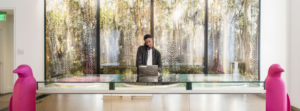
21c Museum Hotel, Durham
For your up-coming holiday travels, do some research into hotels that combine hospitality and culture!

Alex Katz painting in the lobby of the Langham Place, NYC

Set against a bright colourful background adorned with intricate ornamentation sits a poised African American individual. The manner in which the figure sits or stands is familiar. The subject is unflinching, meeting whatever gaze wanders upon their painterly face. Kehinde Wiley’s unique compositions are immediately recognizable.
Wiley’s inspiration draws from classical European painting, which typically captures the drama and triumph of a particular moment. These illustrations of history are retold and monumentalized in textbooks, museums and, most importantly, subconsciously, profoundly influencing who we are as Westerners today.
Yet, this particular strand of art history is notoriously intertwined with a racist rhetoric that has systematically excluded people of colour, along with other non-white groups of people. What happens then, when Wiley appropriates the traditional iconography of European painting with contemporary black figures such as Obama, Ice T, Spike Lee or the Harlem passerby?
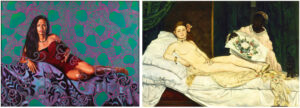
(Left) Kehinde Wiley, Portrait of Kea Loha Mahuta II, oil on linen, 2019 (Right) Édouard Manet, Olympia, oil on canvas, 1863
The answer is complicated, which is why Wiley’s pieces have become so popular and sought after as conversations surrounding decolonization and gender equality proliferate in the media. Wiley employs the ability of paintings to mythologize people, places and events, a considerate feat seeing as history has systemically attempted to eradicate non-white bodies. As seen in classical art, where non-white individuals are depicted as objects, never subjects.
Wiley embellishes his portraits with flowers and golden details which is reminiscent of interior design and craft, mediums that are traditionally associated with femininity. This artistic choice is meant to question the troubling gender dichotomy, a split that attempts to hyper-masculinize men and legitimizes the disenfranchisement of women.
Wiley gained notoriety in 2015 when he was granted a solo exhibition at the Brooklyn Museum untitled, Kehinde Wiley: A New Republic. In 2018, he was commissioned to paint President Barack Obama for the President’s Collection at the Smithsonian Portrait Gallery in Washington.
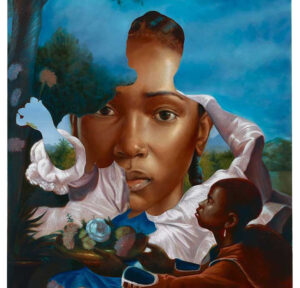
This month, Wiley released a new print, entitled, Head of a Young Girl Veiled, 2019 where all proceeds will go to “Black Rock”, an artist residency program in Senegal.
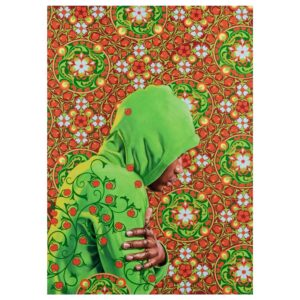
Kehinde Wiley, Head of a Young Girl Veiled, 2019, archival ink, Edition of 30.

Vincent van Gogh, Self-portrait with Bandaged Ear, 1889, Oil on canvas, 24 x 20 inches
Mental Health Day: October 10th
October 10 marks world mental health day which invites a discussion about society’s long-time fascination with mental illness’ pervasiveness in the arts. From Van Gogh infamously cutting off his own ear to present day artist Yayoi Kusama voluntarily living and working in a psychiatric asylum, it is easy to find validity in the clichéd trope of the genius artist plagued with madness. In truth, however, the notion that creative types tend to have mental disabilities is largely unsubstantiated.
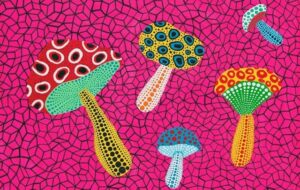
What is noteworthy concerning mental health’s intersection with the arts is the use of art as a form of therapy. Professionals are increasingly turning to creative techniques such as drawing, painting, collage-making and sculpting to help patients artistically express themselves in the hopes of better understanding their feelings and behaviours. Art therapy has proven to improve self-esteem, manage addictions, relieve stress and help alleviate anxiety and depression.
Aside from creating artwork, a new dimension of art therapy is emerging that promotes the simple act of viewing artwork as a legitimate form of mental health treatment. A partnership between the Montreal Museum of Fine Arts and a group of local doctors has launched a pilot project that involves prescribing patients with a trip to the museum. Art’s ability to stimulate neural activity, release hormones and offer escapism is believed to benefit patients suffering from mental illnesses as well as a variety of other health conditions.
What a delight to be offered a prescription free of risky side effects with an added bonus to get a dose of culture.